
Valerie Thomas
Inventor of the Illusion Transmitter
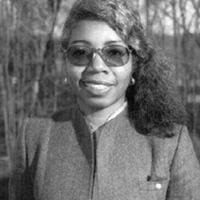
Did you ever think of what it might be like if your television could project the on-screen image directly into your living room as a 3-Dimensional image? Maybe not, but if it happens, you'll have African-American inventor Valerie Thomas to thank for it.
From 1964 to 1995, Thomas worked in a variety of capacities for NASA where she developed real-time computer data systems, conducted large-scale experiments and managed various operations, projects and facilities. While managing a project for NASA's image processing systems, Thomas' team spearheaded the development of "Landsat," the first satellite to send images from space.
In 1976, Thomas learned how concave mirrors can be set up to create the illusion of a 3-dimensional object. She believed this would be revolutionary if technology could be harnessed to transmit this illusion. With an eye to the future, Valerie Thomas began experimenting on an illusion transmitter in 1977. In 1980, she patented it. In operation, concave mirrors are set up on both ends of the transmission. The net effect of this is an optical illusion of a 3-dimensional image that looks real on the receiving end. This brilliant innovation placed Thomas among the most prominent black inventors of the 20th century.
NASA continues to use her technology and is exploring ways to use it in surgical tools and possibly television and video.
Frequently Asked Questions About Valerie Thomas
Who is Valerie Thomas?
Valerie Thomas is an American scientist and inventor known for her groundbreaking work at NASA and for inventing the illusion transmitter, a device that used optical technology to project three-dimensional images.
What did Valerie Thomas invent?
Valerie Thomas invented the illusion transmitter, a device that could create the illusion of three-dimensional images using light and optical reflection. This early imaging technology helped lay groundwork for later developments in 3D visualization.
How does the illusion transmitter work?
The illusion transmitter worked by using concave mirrors and optical principles to create an image that appears three-dimensional to the viewer. It used reflected light in a way that produced a realistic depth effect, long before modern digital 3D technology.
When did Valerie Thomas invent the illusion transmitter?
Valerie Thomas received a patent for the illusion transmitter in 1980. Her invention was based on research she conducted while working as a scientist at NASA.
What was Valerie Thomas’s role at NASA?
Valerie Thomas worked at NASA’s Jet Propulsion Laboratory, where she contributed to data analysis and systems operations for Earth and space science missions. Her work supported satellite imagery, satellite data conversion, and space exploration analysis.
Why is Valerie Thomas’s invention important?
The illusion transmitter has been recognized as an early form of imaging technology that influenced later advances in 3D visualization. While not widely commercialized at the time, her work demonstrated how optical science could be applied to visual communication and simulation.
Where did Valerie Thomas study?
Valerie Thomas earned degrees in physics and mathematics, which formed the foundation for her scientific research and her contributions to technology. Her academic background prepared her for a career in technical research and innovation.
What inspired Valerie Thomas to invent the illusion transmitter?
Thomas was inspired by her interest in optics and visual science. Her work at NASA exposed her to complex imaging systems, and she used her technical knowledge to explore ways of presenting information visually in three dimensions.
Did Valerie Thomas hold patents?
Yes. Valerie Thomas was awarded a patent for her illusion transmitter, highlighting her contribution to imaging technology and optical systems.
How has Thomas’s work influenced modern technology?
Valerie Thomas’s invention and research contributed to the broader understanding of 3D visualization, optics, and imaging. Her work helped demonstrate how light and reflection can be used to create immersive visual experiences, ideas that continue to inform modern display and imaging technologies.
Is Valerie Thomas still alive today?
Valerie Thomas continues to be recognized for her pioneering work as an African American scientist and inventor. Her story remains an inspiration to students and innovators interested in STEM fields.
Where can I learn more about Valerie Thomas’s scientific contributions?
You can learn more through patent archives, NASA historical records, engineering and physics education resources, STEM history profiles, and interviews that explore the developments in optical imaging and space science.
For more information on inventor Valerie Thomas, refer to:
Massachusetts Institute of Technology: Valerie Thomas, Inventor of the Week
Black Inventor Valerie Thomas at "Carmige Servin' It Up – Blog"